Pile Load Testing (Static & Dynamic)
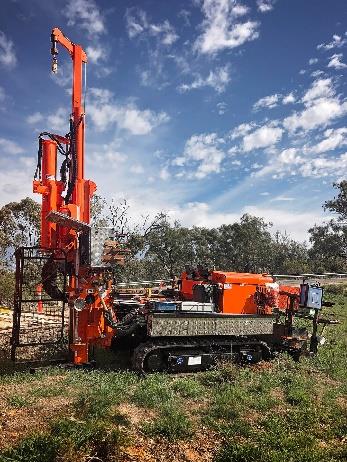
Pile load testing confirms that a pile can safely carry its design load. In a static load test (ASTM D1143), hydraulic jacks push against a reaction system, such as kentledge blocks, anchor piles or a reaction frame, and load is applied to the pile in stages and held while settlement is measured by gauges on independent reference beams. This gives a load-settlement curve and the capacity under the test load. A dynamic load test (ASTM D4945) strikes the pile head with a drop weight or piling hammer while strain gauges and accelerometers record the stress wave. Signal-matching analysis then estimates capacity and pile integrity more quickly, so more piles can be tested on a site.
Pile Integrity Testing
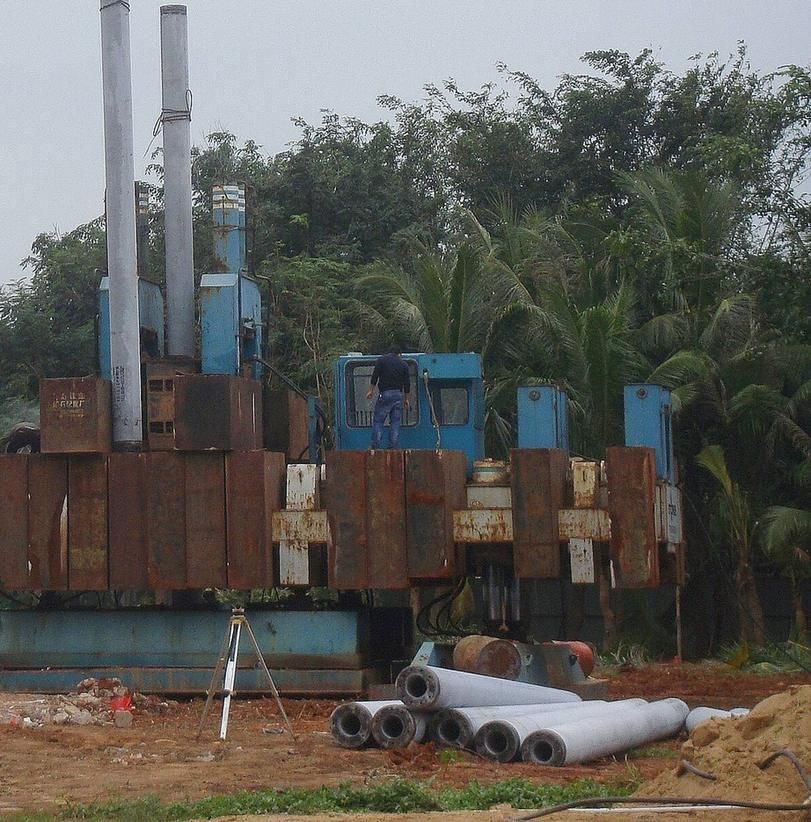
Pile integrity testing checks that a cast-in-place or driven pile is continuous and free of major defects such as necking, voids, soil inclusions or cracks. In the low-strain sonic echo method (ASTM D5882), a technician taps the trimmed pile head with a small hand-held hammer while an accelerometer records the reflected stress wave. Changes in the signal reveal changes in pile cross-section or the pile toe. For large bored piles and diaphragm walls, cross-hole sonic logging (ASTM D6760) passes ultrasonic signals between access tubes cast into the concrete. These tests are fast and non-destructive, so a large proportion of a site's piles can be screened before construction continues.
Water Pumping Tests
A water pumping test measures how easily groundwater flows through the ground and how far water levels drop when water is extracted. A test well is pumped at a controlled, measured rate, while water levels are recorded in the pumping well and in nearby observation wells or piezometers using pressure transducers and dip meters. After pumping stops, recovery of the water level is also monitored. Analysis of the drawdown and recovery curves, using methods such as Theis or Cooper-Jacob, gives aquifer transmissivity, hydraulic conductivity and storage values. Engineers use these results to design construction dewatering, assess effects on nearby structures and evaluate groundwater supply or seepage.
Percolation Tests
A percolation test measures how quickly water soaks into the ground at a specific location and depth. A test hole or trial pit is excavated to the proposed depth, pre-soaked to saturate the surrounding soil, then filled with water, and the fall in water level is timed at regular intervals. The results are expressed as a percolation rate or a soil infiltration rate, following local codes or guidance such as BRE Digest 365 for soakaways. These values are used to size soakaways, infiltration trenches and septic-system drainage fields, to design sustainable stormwater drainage, and to judge whether infiltration is a practical option on a site.
Settlement Analysis
Settlement analysis predicts how much, and how fast, the ground and the structure above it will move downward under the applied loads. Engineers use soil parameters from boreholes, in-situ tests and laboratory tests, such as oedometer consolidation results, CPT data and stiffness moduli, to calculate immediate settlement, primary consolidation and long-term secondary compression. Methods range from classical one-dimensional consolidation theory and elastic solutions to finite-element modelling for complex ground or loading. The analysis also checks differential settlement between parts of a structure. The results show whether foundations will meet serviceability limits and whether ground improvement, preloading or piled foundations are needed.
Bearing Capacity Analysis
Bearing capacity analysis determines the maximum pressure that the ground can support beneath a foundation without shear failure, and from that the allowable bearing pressure for design. Engineers combine foundation size, depth and shape with soil strength parameters, such as cohesion, friction angle, undrained shear strength or SPT and CPT correlations, together with groundwater level. Established methods include Terzaghi, Meyerhof, Hansen and Vesić for shallow foundations, and static or test-based methods for piles. A factor of safety, or the partial factors in Eurocode 7 and similar codes, is applied. The result is checked alongside settlement limits to choose a safe and economical foundation type and size.
Other capabilities in this service
Back to Geotechnical ServicesDiscuss your project with ATLAS GES
Tell us about your site and requirements, and our team will get back to you.
Get in Touch